

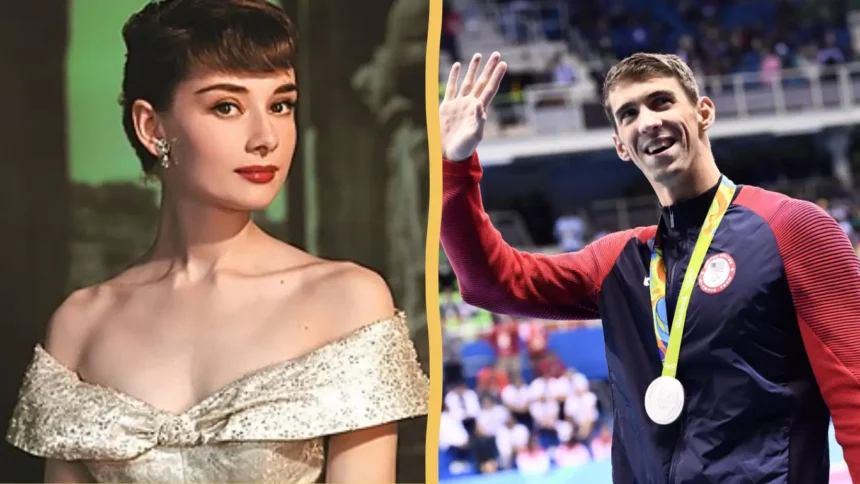
Audrey Hepburn and Michael Phelps come from completely different worlds, yet their names represent exceptional achievement, international recognition, discipline, and lasting influence. Hepburn became one of the defining actresses of Hollywood’s Golden Age before dedicating much of her later life to humanitarian work, while Phelps became the most decorated Olympian in history through an extraordinary swimming career.
There is no established family, romantic, or professional relationship between Audrey Hepburn and Michael Phelps. Their connection is primarily comparative. Hepburn belonged to the world of cinema, fashion, and humanitarian advocacy, while Phelps built his reputation through competitive swimming and later expanded his work into philanthropy and mental-health advocacy. Their lives also belong to different generations: Hepburn was born in 1929 and died in 1993, while Phelps was born in 1985 and began his Olympic career in 2000.
Who Was Audrey Hepburn?
Audrey Hepburn was a British actress and humanitarian who became an international symbol of elegance, cinema, and charitable service. Born on May 4, 1929, in Brussels, Belgium, she spent important years of her childhood in the Netherlands during World War II.
Her early experiences during the war influenced her later humanitarian interests. After the war, she studied ballet and eventually moved toward acting. Her combination of screen presence, grace, and distinctive style quickly made her one of the most recognizable performers of her generation.
Hepburn’s breakthrough came with Roman Holiday in 1953, in which she starred opposite Gregory Peck. Her performance earned her the Academy Award for Best Actress and established her as a major Hollywood star.
Audrey Hepburn’s Hollywood Career
Hepburn’s film career included some of the most recognizable productions of the 1950s and 1960s.
Among her best-known films were Sabrina, War and Peace, Funny Face, Breakfast at Tiffany’s, Charade, My Fair Lady, and Wait Until Dark.
Her performance as Holly Golightly in Breakfast at Tiffany’s became particularly influential. The character’s fashion and personality helped establish Hepburn as a lasting cultural style icon.
Unlike many performers whose fame is primarily connected with one period, Hepburn’s influence continued long after her major acting years. Her films remained popular, while her fashion choices continued to influence designers, photographers, and audiences.
Audrey Hepburn’s Humanitarian Work
One of the most important parts of Hepburn’s legacy came after her greatest period of Hollywood fame.
In 1988, she became a UNICEF Goodwill Ambassador. She traveled to several countries to raise awareness about children facing poverty, hunger, disease, and difficult living conditions.
Hepburn visited communities in Africa, Asia, Central America, and other regions, using her international recognition to draw attention to humanitarian needs.
Her commitment to UNICEF became increasingly important during the final years of her life. She continued traveling and speaking publicly on behalf of children despite serious illness.
Her humanitarian work eventually became as important to her legacy as her film career.
Why Audrey Hepburn Remains Influential
Hepburn’s influence extends across several areas.
She remains recognized for her acting, but her cultural legacy also includes fashion, philanthropy, and humanitarian advocacy.
Her life demonstrates how a celebrity can use international recognition for purposes beyond entertainment. Rather than allowing her later years to be defined only by her earlier films, she devoted considerable energy to humanitarian causes.
That transition helped create a legacy that continues beyond traditional Hollywood fame.
Who Is Michael Phelps?
Michael Phelps is an American former competitive swimmer and one of the most accomplished athletes in Olympic history.
Born on June 30, 1985, in Baltimore, Maryland, Phelps began swimming as a child. His talent became apparent at an early age, and he eventually trained under coach Bob Bowman.
Phelps made his Olympic debut at the 2000 Sydney Games when he was only 15 years old. Although he did not win a medal in Sydney, the experience marked the beginning of a remarkable Olympic career.
Over the next four Olympic Games, Phelps transformed himself into one of the most successful athletes the world had seen.
Michael Phelps and Olympic Success
Phelps competed at the 2000, 2004, 2008, 2012, and 2016 Summer Olympics.
Across those Games, he won 28 Olympic medals, including 23 gold medals, three silver medals, and two bronze medals.
His achievement in Beijing in 2008 was particularly remarkable. Phelps won eight gold medals at a single Olympics, setting a record that became one of the defining achievements of modern Olympic sport.
At the 2012 London Games, he surpassed the previous record for total Olympic medals.
His final Olympic appearance came in Rio de Janeiro in 2016, where he added six more medals, including five golds.
The Discipline Behind Michael Phelps’ Career
Phelps’s success was not based solely on natural ability.
Elite swimming requires years of structured training, technical refinement, recovery, nutrition, competition preparation, and mental focus.
His partnership with coach Bob Bowman was an important part of his development. Bowman worked with Phelps from his teenage years and helped build the training structure that supported his international career.
Phelps also competed across several swimming disciplines, including butterfly, freestyle, backstroke, and individual medley events.
His versatility allowed him to compete in numerous events at major competitions, giving him opportunities to accumulate medals while maintaining an exceptionally demanding training schedule.
Michael Phelps Beyond Swimming
Phelps’s public life did not end when he retired from competitive swimming.
He became increasingly involved in philanthropy and advocacy, particularly through the Michael Phelps Foundation.
The foundation has supported swimming and healthy living programs, with an emphasis on helping young people develop water-safety skills and healthier lifestyles.
Phelps has also spoken publicly about mental health and the challenges he experienced during and after his athletic career.
This part of his life adds another dimension to his legacy. His identity is no longer limited to medals and records; his post-competition work has also focused on helping others.
Audrey Hepburn and Michael Phelps: No Direct Connection
Despite being searched together, there is no established evidence that Audrey Hepburn and Michael Phelps were relatives, close friends, business partners, or collaborators.
Their timelines also make a direct professional relationship highly unlikely.
Hepburn died in January 1993, when Phelps was only seven years old. Phelps did not begin his Olympic career until 2000, several years after Hepburn’s death.
There is also no known film, charitable organization, sporting event, or business venture in which the two worked together.
Their names are therefore best understood through comparison rather than a personal relationship.
Two Different Forms of Excellence
The most interesting connection between Hepburn and Phelps is the way each reached the highest level in a completely different field.
Hepburn worked in an artistic environment where success depended on acting ability, emotional expression, screen presence, timing, and collaboration.
Phelps competed in a highly measurable sporting environment where performance could be recorded down to fractions of a second.
One built a legacy through cinema and humanitarian work. The other built his through athletic performance and later philanthropy.
Yet both became globally recognizable figures whose influence extended beyond their original professions.
Discipline in Two Different Worlds
Discipline is another theme that connects the stories of Hepburn and Phelps.
For Hepburn, developing a successful acting career required adapting to demanding productions, learning performances, working with directors, and maintaining a professional career under intense public attention.
Her early ballet training also gave her experience with physical discipline and performance.
For Phelps, discipline was even more directly measurable. His career required years of repetitive training and preparation for competitions in which tiny differences could determine the outcome.
Their professional environments were completely different, but both required consistency and dedication.
Fame and Responsibility
Hepburn and Phelps also illustrate different approaches to public responsibility.
Hepburn used her fame extensively for UNICEF. Her international reputation gave her access to audiences and media platforms that could draw attention to humanitarian issues.
Phelps has used his post-athletic platform to support swimming, water safety, and mental-health awareness.
Neither legacy is limited to professional achievements.
This is an important reason why their names remain relevant long after their defining careers.
Audrey Hepburn’s Influence on Fashion
Hepburn’s influence was not limited to acting.
Her collaborations with fashion designers, particularly Hubert de Givenchy, helped establish a visual style that remains recognizable decades later.
The simple silhouettes, elegant dresses, cropped trousers, ballet-inspired styling, and understated accessories associated with her public image became part of twentieth-century fashion history.
Her style continues to appear in modern fashion discussions and editorial photography.
This provides another reason why Hepburn remains culturally relevant even among people who may not have watched all of her films.
Michael Phelps’ Influence on Swimming
Phelps similarly changed the visibility of his sport.
Swimming had always been an important Olympic discipline, but Phelps’s extraordinary medal record turned him into one of the most recognizable athletes in the world.
His performances in Beijing, London, and Rio attracted audiences well beyond the traditional swimming community.
Young swimmers could see a pathway from local pools to international competition, while his achievements helped demonstrate the level of specialization required for elite swimming.
His influence therefore extends beyond the medals themselves.
Their Different Approaches to Legacy
Audrey Hepburn’s legacy is strongly associated with elegance, film, compassion, and humanitarian service.
Michael Phelps’s legacy is associated with Olympic excellence, discipline, competitive swimming, perseverance, and advocacy.
These differences make their comparison particularly interesting.
Neither person needed to work in the same industry to achieve global recognition. Their careers demonstrate that influence can emerge from very different forms of talent.
Case Study: Two Global Icons From Different Generations
Audrey Hepburn and Michael Phelps provide an interesting case study in how global icons can emerge from completely different generations.
Hepburn became famous during the mid-twentieth century, when cinema and television were among the most powerful forms of mass entertainment. Her image became associated with classic Hollywood and international fashion.
Phelps emerged decades later, during an era when live sports, digital media, international broadcasting, and social media allowed athletes to develop enormous global audiences.
Despite these differences, both developed identities that went beyond their professional achievements.
Hepburn became a humanitarian ambassador, while Phelps developed philanthropic and advocacy work after his swimming career.
What Audrey Hepburn and Michael Phelps Teach Us About Success
Their stories demonstrate that success does not have one formula.
Hepburn’s career developed through acting, stage performance, fashion, and humanitarian advocacy.
Phelps’s career developed through athletic training, competition, coaching, and an extraordinary commitment to swimming.
Their paths also show that a career can evolve. Hepburn moved from Hollywood toward humanitarian work, while Phelps transitioned from competitive swimming into philanthropy and public advocacy.
A lasting legacy can therefore involve multiple chapters rather than a single achievement.
Frequently Asked Questions
Are Audrey Hepburn and Michael Phelps related?
No established family relationship exists between Audrey Hepburn and Michael Phelps.
Did Audrey Hepburn and Michael Phelps ever meet?
There is no reliable public record establishing that Audrey Hepburn and Michael Phelps met.
What was Audrey Hepburn famous for?
Audrey Hepburn was famous for films such as Roman Holiday, Breakfast at Tiffany’s, Sabrina, My Fair Lady, and Charade. She was also widely recognized for her humanitarian work with UNICEF.
What is Michael Phelps famous for?
Michael Phelps is famous for his swimming career and his record 28 Olympic medals, including 23 gold medals.
How many Olympic medals did Michael Phelps win?
Michael Phelps won 28 Olympic medals: 23 gold, three silver, and two bronze.
What did Audrey Hepburn do for UNICEF?
Hepburn served as a UNICEF Goodwill Ambassador from 1988 until her death in 1993. She traveled internationally to raise awareness and support for children affected by poverty, hunger, disease, and humanitarian crises.
Were Audrey Hepburn and Michael Phelps colleagues?
No. They belonged to different professional fields and generations, and there is no documented collaboration between them.
Why are Audrey Hepburn and Michael Phelps compared?
The comparison is primarily based on their status as internationally recognized figures who achieved exceptional success in different fields and later became associated with philanthropic or humanitarian work.
Final Thoughts
Audrey Hepburn and Michael Phelps represent two very different definitions of greatness. Hepburn transformed herself from a celebrated actress into an internationally recognized humanitarian, while Phelps built one of the most extraordinary competitive records in Olympic history before turning greater attention toward philanthropy and advocacy.
Their lives never developed into a documented personal or professional partnership, and there is no established family connection between them. Their significance lies instead in the separate legacies they created.
Hepburn’s influence continues through cinema, fashion, humanitarian work, and her association with UNICEF. Phelps remains closely connected to Olympic history, swimming, water safety, philanthropy, and conversations around athlete well-being.
Ultimately, Audrey Hepburn and Michael Phelps demonstrate that lasting influence can come from very different places. One found it through film and humanitarian service; the other through sport and athletic excellence. Both became recognizable far beyond the fields in which they first achieved fame.
For More Visits: Trendifymagazine