

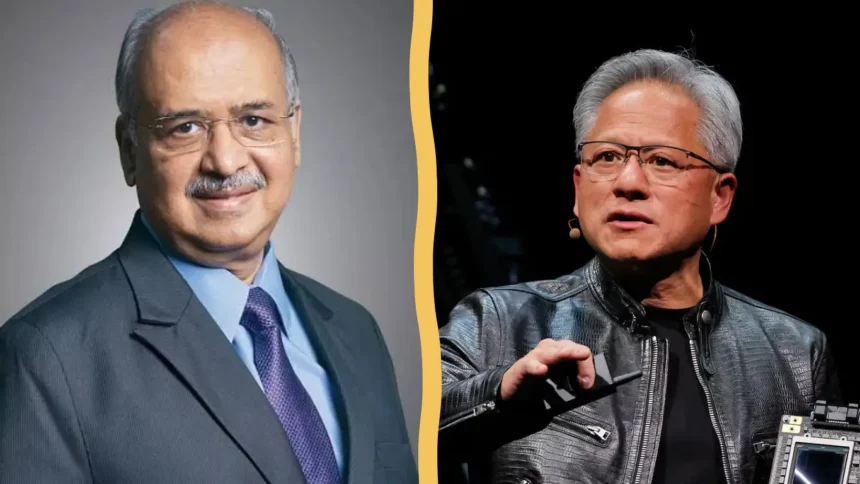
Dilip Shanghvi and Jensen Huang are two influential entrepreneurs whose careers have transformed very different industries. Shanghvi built Sun Pharmaceutical Industries into a major global healthcare company, while Huang co-founded NVIDIA and helped turn it from a graphics-focused technology company into a major force in accelerated computing and artificial intelligence.
Although their names may appear together in business comparisons, there is no widely documented direct business partnership, family relationship, or major collaboration between Dilip Shanghvi and Jensen Huang. Their real connection is more interesting: both demonstrate how long-term thinking, strategic expansion, and a willingness to build around emerging opportunities can shape a global company.
Their stories also represent two very different forms of entrepreneurship. Shanghvi’s journey is rooted in pharmaceuticals, healthcare, acquisitions, and international expansion. Huang’s career is closely connected with semiconductors, graphics processing, computing infrastructure, and AI.
Who Is Dilip Shanghvi?
Dilip Shanghvi is an Indian entrepreneur and the founder of Sun Pharmaceutical Industries. He established the company in 1983 after gaining experience in his family’s pharmaceutical distribution business.
Shanghvi studied commerce at the University of Calcutta. Rather than remaining only within pharmaceutical distribution, he saw an opportunity to manufacture medicines himself. Sun Pharma began on a relatively small scale, initially concentrating on medicines for psychiatric conditions.
Over the following decades, the company expanded its products, manufacturing capabilities, international presence, and research activities. Shanghvi became particularly associated with a strategy that combined organic expansion with acquisitions.
Today, Shanghvi serves as Executive Chairman of Sun Pharmaceutical Industries and remains an important figure in the company’s long-term strategic direction.
The Early Journey of Dilip Shanghvi
Shanghvi’s entrepreneurial story began in a family environment already connected to medicines. His father operated a pharmaceutical distribution business, giving Shanghvi an early understanding of how the industry worked.
That experience helped him recognize an important difference between selling medicines produced by others and developing a company capable of producing its own products.
In 1983, he founded Sun Pharmaceutical Industries. The business initially operated with a focused product portfolio rather than trying to compete across every possible area of medicine.
This approach allowed the company to develop gradually.
Key milestones in Shanghvi’s career include:
- Founding Sun Pharmaceutical Industries in 1983
- Expanding from psychiatric medicines into broader therapeutic areas
- Building international pharmaceutical operations
- Growing through strategic acquisitions
- Expanding Sun Pharma’s research and specialty-medicine activities
- Receiving the Padma Shri in 2016
- Becoming Executive Chairman of Sun Pharmaceutical Industries
Shanghvi’s career demonstrates how a relatively specialized starting point can become the foundation for a much larger international enterprise.
Building Sun Pharmaceutical Industries
One of the defining characteristics of Shanghvi’s business journey has been expansion through acquisitions.
Sun Pharma eventually developed into a multinational pharmaceutical organization with operations and products reaching markets around the world. One of the company’s most significant transactions was its acquisition of Ranbaxy Laboratories, which substantially increased Sun Pharma’s international scale.
However, acquisitions alone do not explain the company’s development.
Pharmaceutical companies have to deal with research, manufacturing, regulatory requirements, product development, intellectual property, distribution, and changing healthcare needs. Shanghvi’s leadership therefore involved balancing immediate commercial opportunities with long-term investments in the pharmaceutical business.
His leadership philosophy has often emphasized measured growth rather than pursuing expansion simply for its own sake.
Who Is Jensen Huang?
Jensen Huang is a Taiwanese-American technology entrepreneur and the co-founder, President, and CEO of NVIDIA.
Unlike Shanghvi, whose educational background is in commerce, Huang followed an engineering and technology-focused path. He studied electrical engineering at Oregon State University and later earned a master’s degree in electrical engineering from Stanford University.
Before NVIDIA, Huang worked in the semiconductor industry. His professional experience helped prepare him for the technological challenges that would eventually shape his entrepreneurial career.
In 1993, Huang co-founded NVIDIA with Chris Malachowsky and Curtis Priem.
The company’s original focus was strongly connected to computer graphics. Over time, however, NVIDIA’s technology became important far beyond gaming and visual rendering.
The Rise of NVIDIA
NVIDIA’s development is one of the most significant technology stories associated with the modern computing industry.
The company’s graphics processing units, commonly known as GPUs, were initially recognized for their ability to handle demanding graphics workloads. As computing requirements changed, the same fundamental technology became increasingly useful for parallel processing.
This created opportunities in areas such as scientific computing, data centers, machine learning, and artificial intelligence.
NVIDIA’s CUDA software platform was particularly important because it allowed developers to use GPUs for general-purpose computing rather than limiting them primarily to graphics.
As artificial intelligence expanded, NVIDIA’s hardware and software ecosystem became increasingly important to companies developing large-scale AI systems.
Jensen Huang and the AI Revolution
Huang’s name became particularly prominent during the rapid growth of generative artificial intelligence.
Modern AI models require enormous amounts of computing power for training and inference. GPUs are well suited to many of these computational workloads because they can perform large numbers of calculations simultaneously.
NVIDIA therefore evolved from being primarily associated with graphics hardware into a broader computing platform company.
Its ecosystem now includes:
- GPUs and accelerated computing hardware
- Data-center technologies
- AI development platforms
- Networking technologies
- CUDA software
- Robotics and autonomous-machine technologies
- Enterprise AI solutions
- Gaming and graphics products
Huang’s leadership has remained closely associated with this transformation.
Different Industries, Similar Long-Term Thinking
The most meaningful similarity between Dilip Shanghvi and Jensen Huang is their ability to think beyond the market conditions that existed when they started their companies.
When Shanghvi founded Sun Pharma, the company was focused on a relatively narrow pharmaceutical segment. Over time, the organization expanded into a much broader international healthcare business.
NVIDIA’s early identity was similarly different from its modern reputation. The company became known for graphics processing, but its technology eventually became central to accelerated computing and AI.
In both cases, the founders were associated with businesses that evolved considerably beyond their original starting points.
Their Approach to Innovation
Innovation means different things in pharmaceuticals and technology.
For Shanghvi, innovation involves areas such as medicines, drug delivery, research, specialty treatments, manufacturing, and new therapeutic opportunities.
Pharmaceutical innovation can require years of research and development, regulatory work, clinical processes, and significant investment before a product reaches patients.
For Huang, innovation has centered more directly on computing architecture, semiconductor technology, software ecosystems, and AI infrastructure.
The timelines and technical challenges are different, but both industries reward companies capable of investing for the future.
Leadership and Company Culture
Another interesting aspect of their careers is the importance of leadership continuity.
Shanghvi spent decades building Sun Pharma and remains connected to its strategic direction as Executive Chairman. His role has evolved as the company developed a broader professional management structure.
Huang, meanwhile, has remained NVIDIA’s President and CEO since its founding.
This gives both companies a strong connection to their founders while allowing their organizations to grow significantly beyond their original size.
Their Global Impact
The impact of Shanghvi’s career can primarily be seen in healthcare.
Sun Pharma’s expansion has contributed to the globalization of an Indian pharmaceutical company, with products and operations reaching markets outside India.
Shanghvi has also received major recognition for his contribution to Indian business and industry, including the Padma Shri.
Huang’s influence is centered on computing.
NVIDIA’s technology has become deeply connected with modern AI infrastructure, data centers, scientific computing, gaming, and advanced digital applications.
Their global influence therefore exists in very different forms.
Dilip Shanghvi’s Business Philosophy
Shanghvi’s career highlights the importance of patience in a complex industry.
Pharmaceutical businesses cannot generally be built overnight. Product development, regulatory requirements, manufacturing capabilities, distribution, and international expansion all require time.
His approach has involved building gradually while making strategic investments and acquisitions.
The broader lessons from his career include:
- Start with a focused business opportunity.
- Understand the industry deeply.
- Expand when the underlying opportunity supports it.
- Use acquisitions strategically.
- Maintain long-term thinking.
- Invest in research and development.
- Build systems that can operate internationally.
Jensen Huang’s Business Philosophy
Huang’s career illustrates a different but complementary form of long-term thinking.
NVIDIA’s success was not simply based on producing faster graphics processors. The company developed an ecosystem around its hardware and software that became increasingly useful as computing workloads changed.
The growth of AI made this strategy particularly important.
Huang’s journey demonstrates several business principles:
- Invest in technologies before their full potential becomes obvious.
- Build an ecosystem rather than relying on a single product.
- Connect hardware and software.
- Anticipate changes in computing demand.
- Continue investing in research and development.
- Adapt the company when a larger opportunity emerges.
Dilip Shanghvi and Jensen Huang Net Worth
Both Dilip Shanghvi and Jensen Huang are frequently discussed in relation to billionaire wealth.
Shanghvi’s wealth is closely connected to his ownership and interest in Sun Pharma, while Huang’s wealth is strongly connected to his NVIDIA holdings.
However, billionaire net worth figures can change substantially because they depend on stock prices, ownership percentages, market conditions, and other financial factors.
For that reason, a particular net worth figure should be treated as an estimate rather than a permanent value.
Case Study: Two Founders Who Adapted With Their Industries
The careers of Dilip Shanghvi and Jensen Huang provide an interesting business case study because neither company’s modern identity is exactly the same as its original identity.
Sun Pharma started as a focused pharmaceutical business and gradually became an international healthcare company.
NVIDIA started in graphics technology and eventually became deeply involved in accelerated computing and artificial intelligence.
The important lesson is not that one industry is more successful than another. Instead, their stories demonstrate the importance of recognizing when an existing capability can serve a much larger market.
Shanghvi recognized opportunities to expand pharmaceutical capabilities and international reach. Huang recognized that GPU technology could become useful for far more than graphics.
Both stories show how companies can evolve when leaders combine existing strengths with emerging opportunities.
Are Dilip Shanghvi and Jensen Huang Related?
There is no widely documented evidence that Dilip Shanghvi and Jensen Huang are relatives.
There is also no well-established public record showing that they are business partners or that they founded a company together.
Their names are mainly connected through comparisons of influential entrepreneurs and business leaders.
Their companies operate in very different sectors, with Sun Pharma focused on pharmaceuticals and healthcare and NVIDIA focused on computing technology, semiconductors, and AI.
Frequently Asked Questions
Who is Dilip Shanghvi?
Dilip Shanghvi is an Indian entrepreneur and the founder of Sun Pharmaceutical Industries. He has played a major role in expanding the company from a small pharmaceutical business into an international healthcare organization.
Who is Jensen Huang?
Jensen Huang is a Taiwanese-American entrepreneur and the co-founder, President, and CEO of NVIDIA. He has led the company since its creation in 1993.
Did Dilip Shanghvi and Jensen Huang start a company together?
No major joint company founded by Dilip Shanghvi and Jensen Huang is widely documented. Their careers developed independently in pharmaceuticals and technology.
What companies are Dilip Shanghvi and Jensen Huang associated with?
Dilip Shanghvi is associated with Sun Pharmaceutical Industries, while Jensen Huang is associated with NVIDIA.
What industries do they represent?
Shanghvi represents pharmaceuticals and healthcare, while Huang represents semiconductors, accelerated computing, artificial intelligence, and technology.
What is the biggest similarity between them?
Both built companies that expanded significantly beyond their original starting points. Their careers demonstrate long-term strategic thinking and adaptation to changing markets.
Final Thoughts
Dilip Shanghvi and Jensen Huang represent two distinct models of modern entrepreneurship. Shanghvi built his reputation by developing Sun Pharma into a major international pharmaceutical company, while Huang helped transform NVIDIA from a graphics technology company into a central player in accelerated computing and artificial intelligence.
There is no established major personal or business relationship between the two men. Their significance lies instead in the contrast between their industries and the similarities in their entrepreneurial journeys.
One built around medicine and healthcare. The other built around computing and AI. Both demonstrate how focused companies can evolve dramatically when their leaders recognize new opportunities and continue investing in the future.
For More Visits: Trendifymagazine