

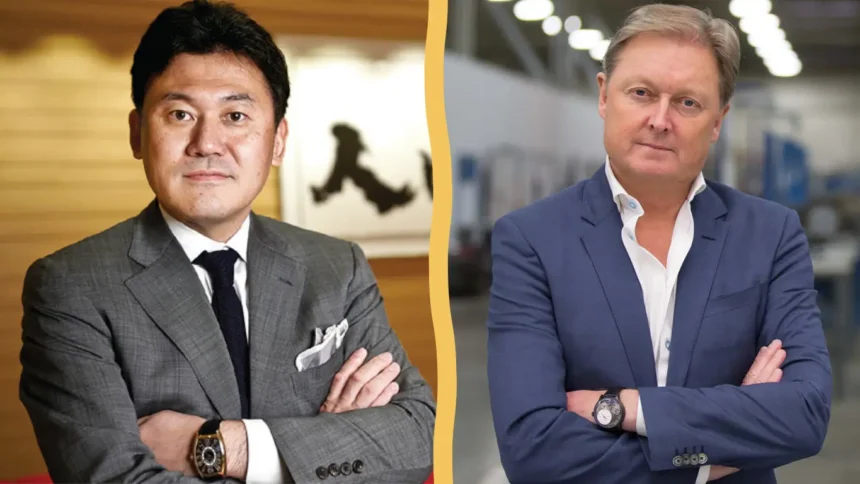
Hiroshi Mikitani and Henrik Fisker are two internationally recognized entrepreneurs who built their careers around innovation, design, and ambitious ideas. Mikitani transformed Japanese e-commerce through the creation and expansion of Rakuten, while Fisker became known for designing luxury automobiles and pursuing electric-vehicle businesses.
Although they operate in very different industries, their professional journeys share several themes. Both developed businesses around changing consumer expectations, both built international ambitions into their careers, and both became closely associated with the companies and products they helped create.
Their stories also demonstrate that entrepreneurship can take very different forms. Mikitani’s career has centered on building a broad technology ecosystem, while Fisker’s career has been driven by automotive design, product development, and the challenge of bringing new vehicle concepts to market.
Who Is Hiroshi Mikitani?
Hiroshi “Mickey” Mikitani is a Japanese entrepreneur best known as the founder of Rakuten. Born in Kobe on March 11, 1965, he studied at Hitotsubashi University before beginning his professional career in investment banking.
He later earned an MBA from Harvard Business School. After leaving the banking industry, Mikitani established Crimson Group and subsequently founded the company that became Rakuten.
Rakuten’s history began in 1997, when Mikitani launched an online shopping marketplace in Japan. The business was built around the idea that the internet could give merchants new opportunities to reach customers.
Over time, Rakuten expanded far beyond online shopping, developing services connected to financial technology, communications, digital content, and other areas.
The Creation of Rakuten
Mikitani founded Rakuten during a period when Japan’s internet economy was still developing.
Rather than attempting to build only a traditional online retailer, he envisioned a marketplace in which independent merchants could establish an online presence. That model helped distinguish Rakuten from businesses focused entirely on selling their own inventory.
The company grew substantially over the following decades.
Today, Rakuten operates a large ecosystem covering areas such as:
- E-commerce
- Fintech
- Mobile communications
- Digital content
- Internet services
- Sports
- Biotechnology
This expansion turned Mikitani’s original e-commerce idea into a much broader technology business.
Hiroshi Mikitani’s Business Philosophy
Mikitani has frequently emphasized entrepreneurship, innovation, and the role of the internet in empowering businesses and consumers.
One of the ideas associated with his approach is the importance of creating value rather than simply following established corporate structures.
His experience in investment banking gave him exposure to traditional business, while Harvard Business School provided an environment in which he studied entrepreneurship and business strategy.
The decision to leave a secure banking career and create his own company became a defining moment in his professional story.
The Impact of the Kobe Earthquake
A major personal event also influenced Mikitani’s thinking about entrepreneurship.
The 1995 Hanshin earthquake devastated Kobe, his hometown. Mikitani’s family was directly affected, and the experience reportedly contributed to his decision to reconsider his career and the way he wanted to spend his professional life.
The event occurred before the creation of Rakuten and became an important part of the story behind his decision to pursue entrepreneurship.
Rather than continuing solely along the conventional corporate path, Mikitani chose to build a company around his belief that the internet could create new opportunities.
Hiroshi Mikitani Beyond E-Commerce
Mikitani’s career eventually expanded well beyond Rakuten’s original marketplace.
His responsibilities and interests have included sports, entertainment, communications, finance, and healthcare-related technology.
He has been involved with Japanese professional sports through Rakuten’s ownership of teams and has also served as chairman of the Tokyo Philharmonic Orchestra.
He has additionally held leadership positions connected with Rakuten Mobile, Rakuten Symphony, and Rakuten Medical.
This broad involvement reflects the evolution of Rakuten from a single online marketplace into a diversified corporate ecosystem.
Who Is Henrik Fisker?
Henrik Fisker is a Danish automotive designer and entrepreneur known for creating distinctive luxury vehicle designs and founding automotive companies.
Born in Allerød, Denmark, on August 10, 1963, Fisker developed an interest in cars from an early age. He later studied transportation design at the ArtCenter College of Design.
His professional career included work with major automotive companies, including BMW, Ford, and Aston Martin.
Rather than focusing only on conventional vehicle engineering, Fisker’s career became strongly associated with design and the visual identity of automobiles.
Henrik Fisker’s Automotive Design Career
Fisker gained recognition for his work on high-end vehicles.
His career included involvement with BMW, where he worked on the design of the BMW Z8, as well as Aston Martin, where he contributed to the design of models including the DB9 and V8 Vantage.
His work demonstrated a distinctive approach to automotive styling.
Fisker’s designs often emphasized long proportions, elegant lines, and a combination of performance-oriented styling with luxury.
His reputation as a designer eventually gave him the foundation to become an entrepreneur in his own right.
Fisker Automotive
In 2007, Henrik Fisker founded Fisker Automotive.
The company’s most recognizable product was the Fisker Karma, a luxury plug-in hybrid vehicle. The car attracted attention because it attempted to combine premium automotive design with alternative powertrain technology.
The project represented an ambitious attempt to challenge established luxury automakers.
However, bringing a new automobile company from concept to large-scale production proved extremely difficult. Fisker Automotive encountered financial and manufacturing challenges and ultimately ceased operations.
Fisker left the company in 2013.
The Creation of Fisker Inc.
Henrik Fisker later returned to the automotive industry with another company.
In 2016, he and his wife, Geeta Gupta-Fisker, co-founded Fisker Inc. The company focused on electric vehicles and sought to combine sustainability with distinctive automotive design.
One of the company’s most important products was the Fisker Ocean, an electric SUV intended to compete in the expanding electric-vehicle market.
The company attracted substantial attention as the global automotive industry shifted toward electric transportation.
However, Fisker Inc. eventually faced serious financial and operational difficulties and filed for bankruptcy protection in 2024.
Henrik Fisker’s Design Philosophy
Design has remained central to Fisker’s professional identity.
Unlike entrepreneurs whose careers begin primarily with finance or software, Fisker’s expertise originated in transportation design.
His work demonstrates how visual design can become a central component of a company’s identity.
For Fisker, an automobile is not simply a transportation product. Its appearance, proportions, materials, interior experience, and relationship with the driver all contribute to how consumers perceive the vehicle.
That design-oriented approach has remained consistent throughout his career, including during his work on electric vehicles.
Hiroshi Mikitani and Henrik Fisker: Different Industries
Although Hiroshi Mikitani and Henrik Fisker are both entrepreneurs, their professional environments are dramatically different.
Mikitani operates in technology, e-commerce, telecommunications, finance, and digital services.
Fisker has primarily worked in automotive design and electric-vehicle development.
Their businesses also have very different structures.
Rakuten developed into a large ecosystem containing numerous interconnected services. Fisker’s companies were more focused on designing, developing, and producing physical automobiles.
Despite these differences, both entrepreneurs built their public identities around innovation.
Innovation as a Common Theme
Innovation is one of the clearest similarities between Mikitani and Fisker.
Mikitani recognized the potential of internet commerce at a time when online shopping was still developing in Japan. He built a marketplace designed to connect merchants and consumers through digital technology.
Fisker recognized opportunities in automotive design and later in electric transportation. His companies attempted to introduce vehicles that combined distinctive styling with alternative powertrain technologies.
Both therefore pursued ideas that challenged conventional approaches within their respective industries.
Leadership and Long-Term Vision
Mikitani’s leadership has focused on expansion and diversification.
Starting with e-commerce, Rakuten developed additional services that could interact with its broader customer ecosystem. This approach created a business model that was much larger than the original online marketplace.
Fisker’s leadership has followed a more product-focused path.
His companies have revolved around individual vehicle concepts and the challenge of bringing those products through design, engineering, manufacturing, and commercialization.
The contrast highlights two different entrepreneurial strategies: building an ecosystem versus building distinctive products.
International Ambitions
Both entrepreneurs developed careers with international dimensions.
Rakuten expanded beyond Japan into multiple markets and industries. Mikitani’s leadership has involved partnerships and operations extending across international technology and business sectors.
Fisker’s career was international from an early stage. A Danish designer working with American and European automotive companies eventually became an entrepreneur operating within the global automotive industry.
The automotive market is inherently international, requiring manufacturers and designers to work across borders, suppliers, production facilities, and consumer markets.
Challenges and Setbacks
The careers of both Hiroshi Mikitani and Henrik Fisker also demonstrate that entrepreneurship involves significant challenges.
Rakuten has had to compete in rapidly changing technology markets while expanding into industries such as mobile communications and financial services.
Fisker’s career has included major setbacks. Fisker Automotive failed to establish sustainable production, while Fisker Inc. later encountered financial difficulties and entered bankruptcy proceedings.
These experiences illustrate an important difference between having an innovative concept and successfully scaling a business.
A strong product idea must ultimately be supported by financing, operations, manufacturing, distribution, customer demand, and sustainable business economics.
Case Study: Two Approaches to Innovation
Consider Mikitani and Fisker as two case studies in entrepreneurial innovation.
Mikitani started with a relatively focused concept: an online marketplace. Instead of keeping the business limited to e-commerce, he expanded it into a larger ecosystem of services.
Fisker began with expertise in automotive design. His entrepreneurial ventures attempted to transform that expertise into complete vehicle businesses.
The difference is significant.
Mikitani’s model demonstrates how a company can expand horizontally into related services. Fisker’s experience demonstrates how difficult it can be to translate design innovation into large-scale physical manufacturing.
Both approaches involve creativity, but they require very different operational capabilities.
Hiroshi Mikitani’s Broader Legacy
Mikitani’s legacy is closely connected with the development of Japanese e-commerce and the international expansion of Rakuten.
His decision to leave investment banking and establish an internet business helped position him among Japan’s most recognizable technology entrepreneurs.
His leadership also contributed to the expansion of Rakuten into areas beyond retail.
The company became involved in communications, financial services, digital content, and other businesses, creating a model in which customers can interact with multiple services within one broader ecosystem.
Henrik Fisker’s Broader Legacy
Fisker’s legacy is closely associated with automotive design.
His work on luxury vehicles established him as a recognized designer before he moved into entrepreneurship.
The Karma and Ocean projects also demonstrated his willingness to experiment with alternative automotive technologies and challenge established manufacturers.
Although his companies experienced major difficulties, his influence as a designer remains an important part of his professional story.
His career illustrates the distinction between creative recognition and the operational demands of running an automotive manufacturer.
Frequently Asked Questions
Who is Hiroshi Mikitani?
Hiroshi Mikitani is a Japanese entrepreneur and the founder of Rakuten. His career is primarily associated with e-commerce, technology, financial services, communications, and digital businesses.
Who is Henrik Fisker?
Henrik Fisker is a Danish automotive designer and entrepreneur known for designing luxury vehicles and founding automotive companies, including Fisker Automotive and Fisker Inc.
What is Hiroshi Mikitani famous for?
Mikitani is best known for founding Rakuten and developing it from an online marketplace into a diversified technology ecosystem.
What is Henrik Fisker famous for?
Fisker is particularly known for automotive design, including work associated with BMW and Aston Martin, as well as his electric-vehicle ventures.
Are Hiroshi Mikitani and Henrik Fisker business partners?
There is no major publicly documented business partnership between Hiroshi Mikitani and Henrik Fisker. Their careers have developed primarily in separate industries.
What company did Hiroshi Mikitani found?
Mikitani founded the company that became Rakuten in 1997. The business initially focused on online shopping before expanding into multiple sectors.
What companies did Henrik Fisker establish?
Fisker founded Fisker Automotive in 2007 and later co-founded Fisker Inc. in 2016 with Geeta Gupta-Fisker.
What happened to Fisker Inc.?
Fisker Inc. experienced significant financial and operational difficulties and filed for bankruptcy protection in 2024.
Final Thoughts
Hiroshi Mikitani and Henrik Fisker offer two very different examples of modern entrepreneurship.
Mikitani built his reputation by recognizing the potential of internet commerce and developing Rakuten into a diversified technology ecosystem. His career has expanded across e-commerce, finance, communications, digital services, sports, and healthcare technology.
Fisker built his reputation through automotive design before moving into entrepreneurship and electric-vehicle development. His career has included celebrated vehicle designs as well as difficult business setbacks.
Their stories demonstrate that innovation can take many forms. One entrepreneur built an expansive digital ecosystem, while the other focused on changing how automobiles look and how they are powered.
Although their industries differ considerably, both careers illustrate the opportunities and risks that accompany ambitious ideas. Their professional journeys remain useful examples of how creativity, technology, design, and entrepreneurship can shape entire industries.
For More Visits: Trendifymagazine