
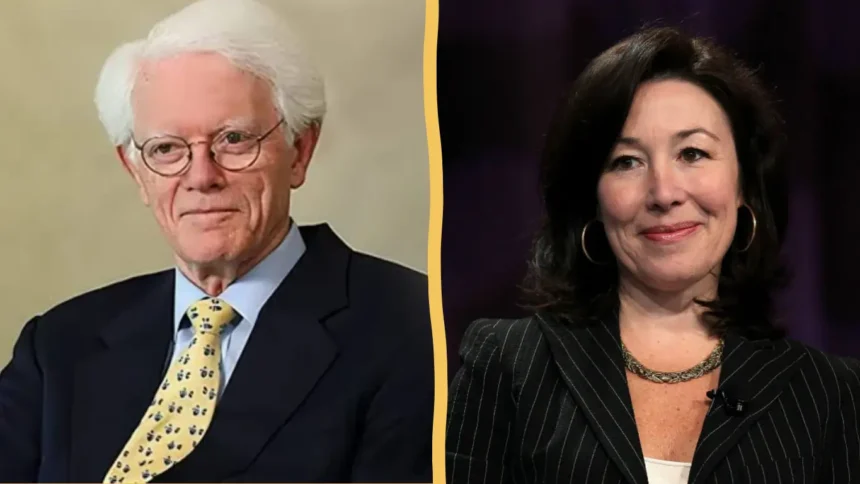
Peter Lynch and Safra Catz are two influential figures whose careers have made a significant mark on the worlds of finance, investment, technology, and business leadership. Although they became known for very different professional achievements, both developed strong connections to finance and the University of Pennsylvania’s Wharton School.
Peter Lynch became famous as an investor and mutual fund manager, particularly through his leadership of Fidelity’s Magellan Fund. His investment philosophy, books, and approach to analyzing companies helped make financial concepts more understandable to everyday investors.
Safra Catz followed a different path. After building experience in investment banking, she joined Oracle and eventually became one of the company’s most important executives. Her career involved corporate finance, acquisitions, strategic planning, and technology leadership.
Despite their shared connection to Wharton and the broader financial world, there is no established evidence that Peter Lynch and Safra Catz are relatives, business partners, or former colleagues. Their stories are better understood as two separate professional journeys that intersect through education and finance.
Who Is Peter Lynch?
Peter Lynch is an American investor, author, philanthropist, and former mutual fund manager who became one of the best-known names in investment management.
Born on January 19, 1944, in Newton, Massachusetts, Lynch developed an interest in finance at an early age. He attended Boston College and later earned an MBA from the Wharton School at the University of Pennsylvania in 1968.
His professional career became closely connected with Fidelity Investments. He joined the company as a research analyst and eventually moved into increasingly senior positions.
His experience researching different industries and companies prepared him for the role that would define his career: managing the Fidelity Magellan Fund.
Peter Lynch and Fidelity Investments
Lynch joined Fidelity during the 1960s and gradually established himself as a skilled researcher and investment professional.
Before becoming manager of Magellan, he served as Fidelity’s director of research. This position gave him extensive exposure to companies across numerous industries and helped shape the analytical approach that later became associated with his investment career.
In 1977, Lynch took over management of the Fidelity Magellan Fund.
At the time, the fund was relatively small compared with the enormous investment funds that exist today. During Lynch’s 13-year tenure, however, Magellan expanded dramatically and became one of the most recognized mutual funds in the United States.
Lynch managed the fund until 1990, when he retired from day-to-day portfolio management.
The Magellan Fund Era
The period from 1977 to 1990 became the defining chapter of Peter Lynch’s career.
During those years, he developed a reputation for conducting extensive research into individual companies and identifying businesses that he believed had strong growth potential.
His investment style was often associated with the idea of understanding what you invest in. Rather than treating stocks as abstract numbers, Lynch encouraged investors to examine the underlying businesses.
He looked at factors such as:
- Company growth
- Earnings
- Debt
- Competitive advantages
- Management
- Industry conditions
- Business models
- Future growth opportunities
His approach helped popularize company-focused investment research among individual investors.
Peter Lynch’s Investment Philosophy
One reason Lynch became so influential was his ability to explain complicated investment ideas in relatively accessible language.
His philosophy emphasized research rather than simply following market excitement. He encouraged investors to understand why a company could grow and whether its financial characteristics supported the investment case.
The phrase “invest in what you know” became strongly associated with Lynch’s approach. However, the concept did not mean that people should automatically buy shares in companies whose products they liked.
Instead, familiarity could provide a starting point for research. Investors still needed to investigate the company’s finances, competitive position, valuation, and prospects.
This distinction became an important part of Lynch’s broader message about investing.
Peter Lynch as an Author
Lynch expanded his influence beyond professional investment management through his books.
One of his best-known works is One Up on Wall Street, which introduced many individual investors to his approach to evaluating businesses and stocks.
He also wrote Beating the Street, which explored investment ideas and strategies in greater depth.
Another important book, Learn to Earn, was designed to introduce readers to the fundamentals of business and investing.
Through these publications, Lynch became more than a professional fund manager. He became a recognizable educator whose ideas reached people who had never worked in finance.
Peter Lynch After Magellan
Lynch retired from managing Magellan in 1990 at the age of 46.
His decision allowed him to spend more time with his family and philanthropic interests. Although he stepped away from daily fund management, his reputation in the investment world continued to grow.
He remained associated with Fidelity and continued to be recognized as an important figure in the company’s history.
Lynch also devoted considerable attention to charitable work, particularly education and organizations serving children and families.
His later career therefore included investment education, philanthropy, writing, and civic involvement.
Who Is Safra Catz?
Safra Catz is an American business executive best known for her long career at Oracle.
Born in Israel, Catz grew up in the United States and developed an academic background that combined business and law.
She attended the University of Pennsylvania, earning a bachelor’s degree from Wharton and later a law degree from the university.
Her education provided a strong foundation for a career that would combine finance, corporate transactions, law, and executive leadership.
Before joining Oracle, Catz worked in investment banking, where she gained experience with corporate finance and major business transactions.
Safra Catz’s Investment Banking Career
Before becoming a major technology executive, Catz developed her professional expertise in investment banking.
She worked at Donaldson, Lufkin & Jenrette, eventually becoming a managing director.
Investment banking provided her with experience in areas such as corporate transactions, financial analysis, mergers, acquisitions, and strategic business decisions.
That experience became especially relevant later in her career because Oracle went through an extended period of expansion involving major acquisitions.
Catz’s financial background became one of the defining characteristics of her leadership style.
Safra Catz and Oracle
Catz joined Oracle in 1999 as a senior executive.
Over the following years, she assumed increasingly important responsibilities within the company. She eventually became president and chief financial officer and served in several senior leadership positions.
Her work became closely connected with Oracle’s acquisition strategy and financial management.
Oracle’s expansion involved acquiring major technology businesses, and Catz played an important role in several of these corporate transactions.
Her responsibilities extended beyond accounting. She was involved in strategic planning, capital allocation, acquisitions, and the integration of businesses into Oracle’s broader corporate structure.
Safra Catz as Oracle CEO
Catz became co-CEO of Oracle in 2014 alongside Mark Hurd after Larry Ellison stepped away from the CEO position.
Following Hurd’s death in 2019, Catz served as Oracle’s sole CEO.
Her leadership period coincided with major changes in the technology industry, including the increasing importance of cloud computing and enterprise infrastructure.
Oracle continued expanding its cloud business and strengthening its position in enterprise technology during this period.
Catz’s background in finance and investment banking remained relevant as the company made major strategic and financial decisions.
Safra Catz’s Role at Oracle Today
Oracle’s leadership structure changed in 2025.
Catz moved from the CEO position to become Executive Vice Chair of Oracle’s Board of Directors, while Clay Magouyrk and Mike Sicilia became Oracle’s CEOs.
This represented a change in her executive responsibilities rather than a complete departure from the company.
Her long tenure at Oracle remains a major part of her professional legacy, particularly her involvement in acquisitions, corporate finance, and strategic growth.
She has also maintained involvement in education and corporate boards outside her primary Oracle responsibilities.
What Connects Peter Lynch and Safra Catz?
The clearest documented connection between Peter Lynch and Safra Catz is their association with the University of Pennsylvania’s Wharton School.
Lynch earned his MBA from Wharton in 1968.
Catz earned her undergraduate business degree from Wharton in 1983 and later received a law degree from the University of Pennsylvania in 1986.
The timing is important because they did not attend Wharton together.
Their educational experiences were separated by approximately 15 years, so the shared Wharton connection should not be interpreted as evidence that they were classmates.
There is also no established public evidence that their university connection developed into a formal mentorship or professional partnership.
Did Peter Lynch and Safra Catz Work Together?
There is no established record showing that Peter Lynch and Safra Catz worked together professionally.
Lynch’s most famous career was built at Fidelity Investments, particularly through his management of the Magellan Fund.
Catz’s defining corporate career developed at Oracle after her earlier work in investment banking.
Their professional responsibilities were also fundamentally different.
Lynch evaluated publicly traded companies and managed an investment portfolio. Catz worked within a large technology corporation, helping make decisions involving finance, acquisitions, operations, and long-term corporate strategy.
Although both careers required extensive financial analysis, they operated from different perspectives.
Are Peter Lynch and Safra Catz Related?
There is no established public evidence that Peter Lynch and Safra Catz are family members.
Their biographies describe separate family backgrounds and independent professional journeys.
The reason their names may appear together is more closely related to their shared connection with Wharton and their prominence in the financial and business worlds.
It is therefore more accurate to describe them as two prominent figures with overlapping areas of expertise rather than members of the same family or business organization.
Peter Lynch and Safra Catz: Two Different Financial Perspectives
One of the most interesting ways to understand Peter Lynch and Safra Catz is by looking at the different roles they played in the financial world.
Lynch primarily approached companies from the perspective of an investor.
His responsibility was to determine whether a publicly traded business represented an attractive investment opportunity. He studied financial statements, industries, management teams, products, competition, and growth prospects.
Catz approached financial decisions from inside a corporation.
Her work involved determining how Oracle should use its resources, which companies it should acquire, how acquisitions should be integrated, and how financial decisions could support long-term corporate objectives.
Both roles require financial expertise, but the goals are different.
Lynch evaluated where capital should be invested, while Catz helped determine how a major company could deploy its own capital and resources.
The Importance of Their Wharton Connection
Wharton represents an important common point in the professional biographies of Lynch and Catz.
For Lynch, the school provided graduate-level business education before he became one of Fidelity’s most recognized investment managers.
For Catz, Wharton formed part of an educational path that combined business with legal training and eventually led to a career in investment banking and technology leadership.
Their careers demonstrate how the same educational environment can lead to very different professional outcomes.
One graduate became a celebrated investment manager and financial author. Another became a major corporate executive in the global technology industry.
Peter Lynch’s Influence on Individual Investors
Lynch’s influence extends beyond professional fund management because he helped make investment analysis understandable to ordinary people.
His writing encouraged readers to become more curious about businesses and financial markets.
Instead of assuming that successful investing required an extremely complicated system, Lynch often emphasized the importance of learning how businesses operate.
His books remain associated with long-term investment education and company research.
His approach also encouraged investors to think independently rather than simply following market trends or popular opinions.
Safra Catz’s Influence on Corporate Leadership
Catz’s influence developed through a different channel.
Her career illustrates how financial expertise can become a foundation for broader corporate leadership.
At Oracle, she moved beyond traditional financial responsibilities and became involved in major strategic decisions affecting the company.
Her investment-banking background was particularly relevant to mergers and acquisitions, while her experience as a senior Oracle executive gave her insight into operations and long-term business strategy.
Her career is therefore an example of how financial knowledge can lead into broader executive responsibilities.
Case Study: Two Paths From Finance to Influence
Peter Lynch and Safra Catz provide two distinct examples of how financial expertise can shape a career.
Lynch began by developing expertise in research and investment analysis. His career progressed from analyst to research director and eventually to manager of one of the world’s best-known mutual funds.
Catz developed expertise in investment banking before moving into technology leadership. Her career progressed through increasingly senior positions at Oracle before she became CEO.
The two journeys demonstrate that finance can serve as the foundation for very different professional directions.
One path can lead toward investment management and financial education. Another can lead toward corporate leadership and strategic decision-making.
Neither career needs to be directly connected to the other to be significant.
Frequently Asked Questions (FAQs)
Are Peter Lynch and Safra Catz related?
There is no established public evidence that Peter Lynch and Safra Catz are related by family.
Did Peter Lynch and Safra Catz attend Wharton together?
No. Peter Lynch earned his Wharton MBA in 1968, while Safra Catz earned her undergraduate degree from Wharton in 1983.
Did Peter Lynch and Safra Catz work together?
There is no documented professional collaboration between them. Lynch is primarily associated with Fidelity Investments, while Catz is primarily associated with Oracle.
What is Peter Lynch famous for?
Peter Lynch is best known for managing Fidelity’s Magellan Fund from 1977 to 1990 and for writing influential books about investing.
What is Safra Catz famous for?
Safra Catz is best known for her long career at Oracle, where she held senior financial and executive positions and served as CEO.
Is Safra Catz still Oracle’s CEO?
No. Catz moved from the CEO role in 2025 and became Executive Vice Chair of Oracle’s Board of Directors.
What do Peter Lynch and Safra Catz have in common?
Both have strong backgrounds in finance and business and both attended the University of Pennsylvania’s Wharton School, although in different years and programs.
Did Peter Lynch work at Oracle?
No. Lynch’s defining professional career was at Fidelity Investments, especially as manager of the Magellan Fund.
Did Safra Catz work at Fidelity?
There is no established record of Catz working at Fidelity. Before joining Oracle, she worked in investment banking at Donaldson, Lufkin & Jenrette.
Final Thoughts
Peter Lynch and Safra Catz represent two distinct approaches to finance, leadership, and business.
Lynch became famous for his work as an investment manager at Fidelity and for developing an accessible way of discussing company analysis and investing. His management of the Magellan Fund established him as one of the most recognizable investment figures of his generation.
Catz built her reputation through investment banking and a long executive career at Oracle. Her work involved corporate finance, acquisitions, strategic planning, and technology leadership, eventually leading her to the company’s CEO position.
Their strongest documented connection is their association with the University of Pennsylvania’s Wharton School. Lynch earned his MBA there in 1968, while Catz studied at Wharton in the 1980s.
Beyond that educational connection, their careers developed independently. There is no established evidence that they are relatives, former colleagues, or business partners.
Their stories are nevertheless useful to consider together because they demonstrate two different ways financial knowledge can shape a professional career: one through investment management and financial education, and the other through corporate strategy and executive leadership.
For More Visits: Trendifymagazine